

Higher education’s “Napster moment”
Higher education’s “Napster moment”
Annals of Disruption: will a new initiative from Sal Khan change college forever?
By Brad Berens
This week’s column is about disruption and higher education. My colleagues at the Center for the Digital Future, Jeffrey Cole and Harlan Lebo, have a book about disruption coming out on September 22: Disrupters at the Gate: When Visionaries, Trailblazers, and Two Guys in a Garage Turn the World Upside Down. You can pre-order here.
__________
An April story about the new Khan TED Institute (KTI) had a moment, but then faded away. It deserves a second look.
KTI is the brainchild of Sal Khan, creator of the Khan Academy, TED, and the Educational Testing Service (ETS), alongside what Khan, in his announcement video, calls “corporate thought partners” (a bloodless phrase) including Microsoft, Google, Bain, Accenture, and McKinsey.
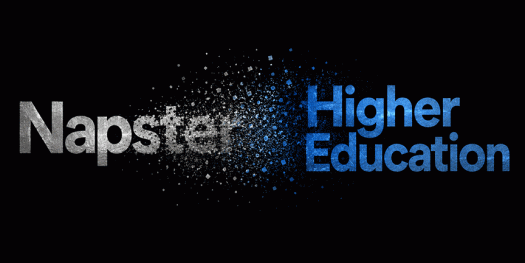
I created this file using ChatGPT.*
KTI’s first offering will be a $10,000 bachelor’s degree in Applied AI. It will take two to three years for students to complete the degree. Coursework will mostly be asynchronous and AI-driven. Progress will depend on mastering skills rather than completing courses. The corporate thought partners will help to define the skills that graduates will need to get jobs.
At first blush, this is both a) a good idea, and b) nothing new. Google launched “Google Career Certificates” back in 2020 along the same lines, promising a six-month duration of classes that would then qualify candidates for in-demand jobs at Google and elsewhere.
What is new about KTI, and what surfaced in the April coverage, is that it is seeking academic accreditation.
This is a big deal. It distinguishes KTI from the many courseware, EdTech, MOOC, corporate Learning and Development platforms, iTunes U, The Great Courses, numberless videos on YouTube, and other unaccredited instructional ventures that emerged over the past few years.
Instead of a nice certificate of completion that a student can print out or pin to a LinkedIn page—but which does not translate into any other educational currency—if KTI gets accredited its courses will participate in the currency of academic credits, allowing coursework from other universities to translate into KTI and KTI credits to translate out to other universities.
All currencies are consensual hallucinations; the hallucinations are powerful moats that keep some things inside and some things outside. Every other new form of education since the dawn of the web has not been able to get inside.
To see why this is a big deal, it helps to look back to 1999, when the music biz faced its own industry-shattering disruption.
How Napster changed everything
Before Napster burst onto the scene, the record labels and the Recording Industry Association of America (RIAA, the industry trade association) controlled how music was created, packaged, distributed, and purchased.
In what my colleague Jeffrey Cole calls “extortion,” the labels and RIAA sold albums, tapes and CDs containing a dozen songs that a customer had to buy in order to get the song or two that she really wanted. Music lovers could create mixtapes for friends that combined songs from different albums, but that took time and effort. (It was also a way to convey romantic interest.)
Then came Napster. The platform allowed music lovers with internet-connected computers and CD-ROM drives to digitize (or “rip”) music from their CDs and upload the songs as individual mp3 files to what today we’d call the cloud. Other Napster users could download the mp3s for free.
Napster had no revenue model, was flagrant piracy, and triggered immediate and bloodthirsty lawsuits from the labels and RIAA. In its original peer-to-peer form, Napster only survived until 2002, but the damage was irreversible. The extortionist 12-song container was gone (as was, sadly, the album as a Pet Sounds-like whole greater than the sum of its parts). The atomized new container was an mp3.
The music biz story was far from over. From Napster emerged iTunes (which legitimized individual mp3 purchase), and from iTunes emerged Spotify (which replaced purchase with streaming).
What’s important about the KTI / Napster comparison?
Back in 1999, nobody sympathized with the record labels and RIAA. There was a Robin Hood glee to sticking it to the labels who had pillaged our savings accounts for so long. Plus, it was well known that the labels shafted the artists, the people who created the music. For every superstar act that made millions there were thousands of musicians who couldn’t make a living. As Rebecca Giblin and Cory Doctorow showed in their remarkable 2022 book Chokepoint Capitalism, not much has changed since.
The labels drove up prices, screwed the people doing the actual work, and made customers spend more money and time than they wanted to spend.
Sound familiar?
Today, even the most cost-effective university degree costs a lot more than $10,000. Between 1980 and 2025, the cost of higher education increased by 1,249.85% at a rate nearly twice the general inflation rate. $20,000 of education in 1980 cost $270,000 in 2025 (Bureau of Labor Statistics). The most elite undergrad degrees recently crossed the $100,000 per year mark.
Plus, a bachelor’s degree typically takes four years to achieve.
Like Napster with music, KTI shatters the typical four year container and is a bargain. It’s also far more get-a-job-oriented than the typical undergraduate degree.
Also like Napster, customers (that is, students) won’t have empathy for university administrations. The comparison looks like this:

If KTI both gets accredited and achieves any measure of success, fast followers will flood the higher education market with more options.
I have happy memories of college and think it was a good investment, but that is not the majority opinion today. In an eye-popping study from Indeed, 51% of Gen Z college graduates think their degrees were a waste of time and money; 68% think they could do their jobs without a college degree.
Knock-on effects
Over the last few years, smaller college have begun closing up shop because they can’t compete with cheaper online degrees. KTI and its followers will add pressure to these struggling schools.
Community Colleges will also suffer, especially those that are pipelines to four year universities with a value proposition under evolutionary pressure.
In a classic example of The Innovator’s Dilemma, today’s colleges and universities are unlikely to pivot fast enough to compete.
It’s obvious that KTI is bad news for today’s colleges and universities.
A more important question is “who is it good for?” Time will tell.
__________

Brad Berens is the Center’s strategic advisor and a senior research fellow. He is principal at Big Digital Idea Consulting. You can learn more about Brad at www.bradberens.com, follow him on Blue Sky and/or LinkedIn, and subscribe to his weekly newsletter (only some of his columns are syndicated here).
* Image Prompt: “Create an image of the word ‘Napster’ dissolving into the words ‘Higher Education.’”
__________
Links and Further Reading
April coverage of KTI from:
Sal Khan’s KTI announcement video on YouTube.
Google Career Certificates (Inc. Magazine, Aug 19, 2020)
I talked about mix tapes and the movie High Fidelity, among other things, in this 2015 column.
I wrote about Chokepoint Capitalism here.
Numbers from the Bureau of Labor Statistics.
The Indeed study about Gen Z unhappiness with their degrees.
See all columns from the Center.
June 17, 2026