

Wonder Moments
Wonder Moments
When something makes you notice and appreciate the technological marvels that we all take for granted, pay attention.
By Brad Berens
Last Wednesday, my first meeting was a Zoom with one person in Warsaw (6,000 miles away) and another in Palo Alto (a mere 350 miles away). I’m in Los Angeles visiting family. I have global meetings like this all the time, but for some reason it struck me afresh how incredible it is to have such a face-to-face-to-face meeting across two time zones and three geographies.
Later that day, I was driving to Pasadena to meet a friend for coffee when my son William texted me a question from Auckland. I couldn’t text back (driving), so I hit the little button and called him. “Hi Pop,” he answered. We chatted for a minute or two about his question, then he disconnected, and I kept driving. Huh, I thought to myself. Isn’t that amazing?
Auckland is 6,500 miles away in an entirely different direction than Warsaw. In the between hours, I’d had meetings with people elsewhere in California, in Oregon, Chicago, New York and the Philippines. These are typical events in my life, and most of the time I don’t notice.
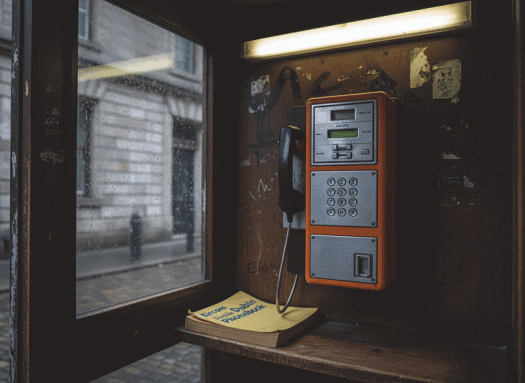
I created this image using Adobe Firefly.*
Decades earlier in the 1980s, I did my own study abroad at Trinity College Dublin. At that time, I traded letters and postcards with friends and family: each piece of mail was a dislocated snapshot of our lives. Sunday phone calls to my parents were expensive and brief.
One day, the pay phone in Trinity Hall (the dorm for international students) started giving out free calls to anywhere on the planet. We all took turns calling faraway friends and family. It was terrific, so long as you didn’t mind a loud beep! interrupting your conversation every 20 or 30 seconds. Nobody minded. Soon, two large men from Telecom Éireann walked into the lounge, ripped the pay phone out of the wall, and walked back out.
Those free calls, talking in real time, without anxiety about how much each minute cost, were delicious. I could hear voices that for months had been handwriting. That was in the 1980s.
Today, I have unlimited, low-cost or free communications with anybody I want to chat with—audio and video—anywhere on the planet. The confluence of my global Zooms and then casual chat with William in New Zealand jarred me out of my automatic, habitual acceptance of these remarkable, enabling technologies.
It was a Wonder Moment.
Wonder Moments are the precious, positive flip side of Adapt-amnesia, which happens when we get so accustomed to something (e.g. high-speed internet) that we forget browsing used to be slower until, yikes, we have to use a low-speed connection again and go nuts because we don’t want to wait. They can be a form of time travel, but unlike specific evocations of time past Wonder Moments can also make you see the present from a new angle.
Tripping over a Wonder Moment means falling into appreciation, seeing, noticing, embracing the parts of an experience that don’t fit into habitual schemas or System 1’s easy heuristics. In a Wonder Moment, the outside world remains the same. The only thing that changes is your perspective.
Wonder Moments happen when something startles us into shifting from one kind of thinking to another. Different thinkers describe this shift in different, complementary ways.
In 1917, in his famous essay “Art as Device,” the Russian Formalist critic Viktor Shklovsky articulated the difference between seeing and recognizing. To see a thing was to experience it in depth, in context, and vividly. To recognize a thing was, by comparison, an impoverished experience. The purpose of art, he argued, was to make things strange so that we could stop recognizing and see them once again. His term for this strange making was ostranenie, one of the most useful ideas I’ve come across.
Social psychologists distinguish between data-driven thinking and schema-driven thinking, where the first is similar to Shklovsky’s seeing and the second is like his recognizing. Data-driven processing is more resource intense than schema-driven. Data-driven processing also makes things seem to last longer, which is why a long weekend away in a place you’ve never been to before can seem like a week.
Likewise, in Thinking, Fast and Slow, Daniel Kahneman distinguished between laborious and lazy System 2 thinking (the slow kind) and lightning-quick but inaccurate System 1 thinking (the fast kind). We need both to navigate the vast—and increasing—amount of information in our moment-to-moment lives. If we only used System 2, then we’d run out of mental energy before finishing that second cup of coffee in the morning. However, System 1 makes a lot of mistakes that can get us into trouble.
Tripping over a Wonder Moment means falling into appreciation, seeing, noticing, embracing the parts of an experience that don’t fit into habitual schemas or System 1’s easy heuristics.
In a Wonder Moment, the outside world remains the same. The only thing that changes is your perspective. This is akin to the vestigial Jewish notion of heaven versus hell. They are the same place, but when you’re in heaven you can appreciate it, and when you’re in hell you can’t: same place, different experience. A Wonder Moment changes your experience, and you don’t move a muscle.
I don’t get Wonder Moments all that often, so when I do I try to embrace them. Wonder Moments are a caesura, a pause, a brief frozen moment that then thaws into the rushing water of quotidian experience. If I’m lucky, I can notice the temperature, feel the wetness on my skin, and float rather than sink beneath the rest of my day.
__________

Brad Berens is the Center’s strategic advisor and a senior research fellow. He is principal at Big Digital Idea Consulting. You can learn more about Brad at www.bradberens.com, follow him on Blue Sky and/or LinkedIn, and subscribe to his weekly newsletter (only some of his columns are syndicated here).
* Image Prompt: “An old-style, 1980s era pay phone, in Dublin, Ireland, mounted on a wall in a wooden cubicle with a shelf below. On the shelf is a paper phone directory.”
See all columns from the Center.
February 24, 2026